Kumon Alternatives: 7 Options Families Choose Instead (2026)
By Rumee Shahid ·
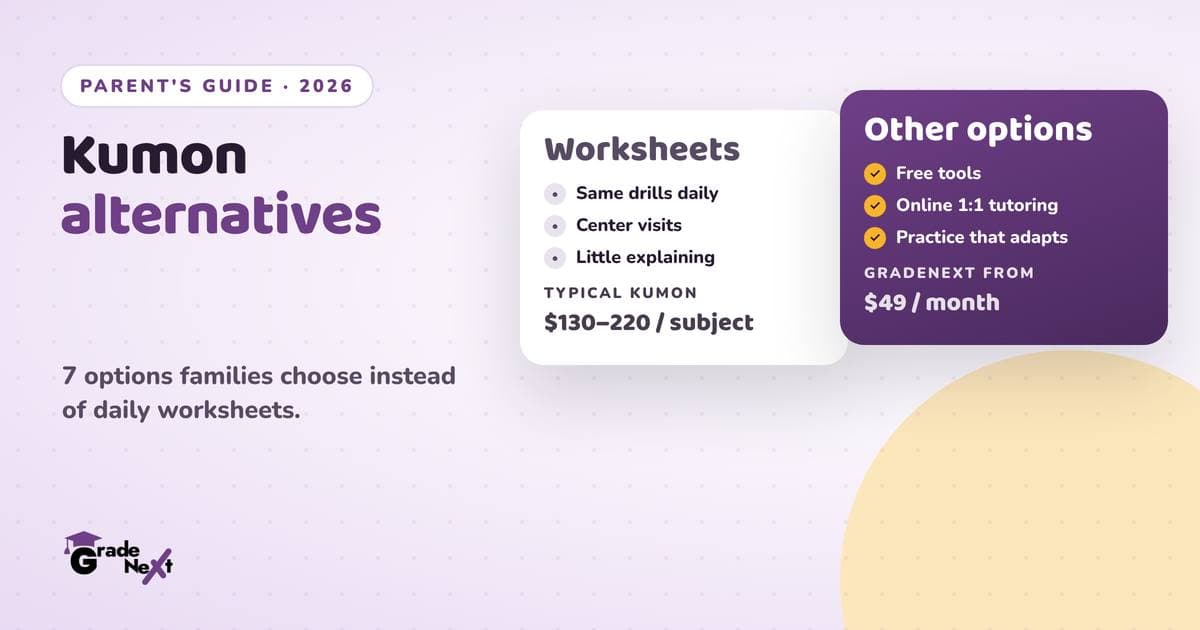
Popular Kumon alternatives include free tools like Khan Academy and library tutoring, workbooks at home, and programs with real teaching such as GradeNext, Mathnasium, Cuemath or a private tutor. Kumon costs about $130 to $220 per subject per month per a September 2026 ThePricer roundup, while GradeNext plans start at $49 a month.
Kumon has helped millions of kids, and it might be exactly right for yours. But if the worksheets have turned into a nightly battle, or the cost and twice-a-week drive aren't working, it's fair to look around.
This guide walks through seven Kumon alternatives families choose instead, from free to full tutoring, with honest notes on who each one suits.
Why parents look for Kumon alternatives
Kumon is built on self-learning. Kids work through worksheets in small steps and figure things out from built-in examples, with an instructor giving "just enough" guidance, as the Kumon Method page explains. That's great for building speed and a daily habit.
It's harder for kids who:
- Don't understand why a method works and need it explained
- Get bored by repetition
- Need help beyond math and reading
Cost is the other reason. A September 2026 ThePricer roundup put Kumon at about $130 to $220 per subject, per month, plus a registration fee often around $50 to $80. Prices vary by center, so check locally.
Free and low-cost Kumon alternatives
1. Khan Academy
Khan Academy is a free nonprofit with K-12 math, reading and more. Short videos plus practice make it a strong alternative to Kumon for math review. You'll need to keep your child on track yourself.
2. Library and school tutoring
Many public libraries offer free online tutoring with a library card, and many schools run homework clubs or small-group help. Ask your librarian and your child's teacher. It costs nothing to ask.
3. Workbooks at home
If what you liked about Kumon was the daily routine, a grade-level workbook and 15 minutes a day can keep that going. It works best when you can sit nearby and help when your child gets stuck.
Kumon alternatives with real teaching
4. GradeNext
This is us, so take our bias into account. GradeNext pairs short daily practice with a real person who explains concepts. Plans start at $49 a month for math, science and language arts practice, with 24/7 live doubt support and a parent progress dashboard. The Pro plan ($99 a month) adds a weekly one-on-one tutor session.
It's fully online, so there's no drive. It's a good fit if your child needs the "why," not just more sheets. See how GradeNext works or our page on GradeNext as a Kumon alternative.
The honest trade-off: if your child wants an adult in the same room, an in-person option may suit them better.
5. Mathnasium
If you want a Kumon alternative for math with in-person help, Mathnasium is the best-known option. It starts with an assessment, builds a plan, and teaches at a center (some locations offer online). It's usually pricier: ThePricer's August 2026 roundup found about $250 to $550 a month, varying by center.
6. Cuemath
Cuemath offers live 1:1 online math classes. Its US pricing page lists about $15 to $28.50 per class depending on grade and plan, paid in 6- or 12-month plans. Good for lots of live tutor time, but it's math only and a longer commitment.
7. A private tutor
A local tutor gives the most personal attention, and can work around your schedule. Rates vary widely by area and experience. Ask for a trial session first.
How to pick the right one
Ask yourself one question: does your child need more practice or more explaining?
- More practice, motivated kid: Khan Academy or workbooks.
- Needs explaining, tight budget: an online program with a tutor.
- Far behind or anxious: more live 1:1 time, online or in person.
If math gaps are the worry, our guide on helping a child who's behind in math has practical first steps.
Quick comparison: which option fits which family
Every family is different, so the best Kumon alternative depends on what you need most. Here is a quick way to narrow it down:
- Tight budget, motivated child: free tools like Khan Academy and library programs.
- Child needs structure at home: workbooks with a set daily routine.
- Child is behind and needs real teaching: a program with one-to-one live help.
- Busy schedule, no driving: online programs that fit after school or weekends.
- Specific gaps or test prep: a private tutor for a set number of weeks.
Whichever you choose, give it at least a few weeks before judging. Ask your child how it feels, look at their schoolwork, and check whether their confidence is growing. Those signs matter more than how many worksheets they finish.
It also helps to involve your child in the choice. Let them try one or two options and ask what they liked and what felt hard. Kids who feel heard are more likely to stick with a program, and sticking with it for a few months is what turns small daily practice into real progress at school.
See if it clicks, free
Want to try a Kumon alternative without the commitment? Start GradeNext's 14-day free trial, no card needed, cancel anytime. Or book a demo and ask us anything.
Frequently asked questions
What is a good alternative to Kumon?
It depends on your child. For free practice, Khan Academy works well. If your child needs concepts explained, an online program with a tutor, like GradeNext, or a math center like Mathnasium is a better fit.
What is the best Kumon alternative for math?
If your child needs more explaining than practice, look for live teaching: GradeNext's Pro plan adds a weekly 1:1 tutor session for $99 a month, Cuemath offers live 1:1 online classes, and Mathnasium teaches in centers.
Is there a cheaper alternative to Kumon?
Yes. Khan Academy and many library tutoring services are free. GradeNext plans start at $49 a month and cover math, science and language arts, compared with about $130 to $220 per subject per month for Kumon per a September 2026 roundup.
Weighing your options? Compare online tutoring with in-person learning centers.